About Me
Welcome! This website is a showcase of my journey through IT. Throughout my life, I’ve embraced challenges and found joy in creating solutions. From personal hobbies and academic pursuits to professional experience, each step has helped grow my skills and knowledge.
If you’d like to jump straight into my projects, feel free to use the links below. Otherwise, scroll down to learn a bit more about me!
Key Work Projects (WIP)
These are some of the key projects I've been involved in, showcasing my skills and experience with various companies.
Personal Endeavors (WIP)
I also run a homelab that’s evolved into a full private cloud for personal use, technical training, and devlopment. It’s a project that’s grown steadily over the years and has become part of my everyday life—including hosting this very website.
Resume
Check here if you're looking for my resume.
Quick links
Early life and education in IT

IT has been a big part of my life ever since the days of Windows 95; though back then, it was more about playing Rodent’s Revenge than actually working on computers. Things really picked up with Windows 98, when I started learning how to build PCs and discovered Microsoft FrontPage to create websites for the then-new Half-Life: Counter-Strike mod. I still remember the excitement around Windows 98 SE, especially the improved Plug and Play and USB support. No more rebooting every time a cable got knocked loose!
In middle school, I joined the Student Technology Leadership Program, which gave students the opportunity to assist with troubleshooting and computer support under the guidance of the school’s IT Director. I was fortunate to be selected and stayed involved through high school, where I participated in a four-year IT internship for returning students.
Alongside that, I had the privilege of learning from a dedicated teacher, Mrs. Slusher, who taught A+ and programming courses in Visual Basic, C++, and Java. Thanks to her mentorship and the hands-on classroom experience, I earned college credit in multiple programming classes and achieved my first certification, CompTIA A+, before graduating.
College education experience
College always starts with a plan, but not everything goes according to it. I began at Thomas More University on a full-workship, working as a junior system administrator and help desk staff while studying Computer Information Systems. During my first year, I completed core studies and had the chance to publish my first piece of code to Symantec, contributing an ISO loader for Norton Ghost that automatically detected PATA vs. SATA IDE drives and loaded the appropriate imaging drivers; a small but meaningful milestone for me.
After Thomas More, I was accepted into the Computer Science program at Montana State University. There, I dove deeper into advanced programming, robotics, and artificial intelligence coursework. Despite the cold, it was an incredible opportunity, and with so much time spent indoors, I began working heavily on video game modding, especially in Minecraft, which had just launched and was written in Java.
That hobby quickly turned into a business opportunity. I began collaborating with other mod developers and eventually co-founded an LLC; HiveHosted.com, a custom game server hosting provider for various platforms. It was my first real taste of entrepreneurship and infrastructure management. Unfortunately, circumstances required me to return to the Greater Cincinnati area, and I sold my share of the company.
Back home, I enrolled at the University of Cincinnati, where I continued studying Information Technology while working for the Campus Operations IT department. There, I gained hands-on experience in networking, cabling, physical access systems, and PCI compliance in supporting the Bearcat Card system used by students and staff (powered by PNC Bank). Among many projects, two stand out:
Modifying routers with DD-WRT to provide a wireless connection for roaming wired card readers aboard campus transit buses.
Being one of two in wiring network and security infrastructure during the construction of new dormitory buildings.
It was a transitional period that kept me grounded, and constantly growing, both academically and professionally.
College and post-college work experience

Toward the end of my college years, I began working remotely for Support.com, a technical BPO that provided white-labeled support for companies like Norton, Comcast, Time Warner, Office Depot, OfficeMax, Staples, and others. My role focused on technical customer support, PC setup, system optimization, and malware removal. I started as Tier 1 support, and within six months was promoted to Tier 2, gaining hands-on experience with consumer hardware, software, and small office/home office networking across a wide range of service cases.
This role also marked my first exposure to creating internal documentation. I began contributing to the knowledge base, assisting with training new technicians, and helping to identify zero-day issues as they emerged in the field.
After my time at Support.com, I transitioned to Staples as a Tier 2 Specialist. Staples was shifting away from Support.com and launching its own Technical Support Operations Center (TSOC). My responsibilities expanded to include not just technical support, but also internal tool development. I used AutoIT to build documentation tools and resolution scripts, which became the department’s standard for delivering consistent service.
I authored a majority of the internal scripts, reports, and task-based documentation used by the team to guide and complete service requests. This period deepened both my technical and procedural skills while placing me in a position to help shape the operational workflow of a growing support center.
Homelab to Private Cloud
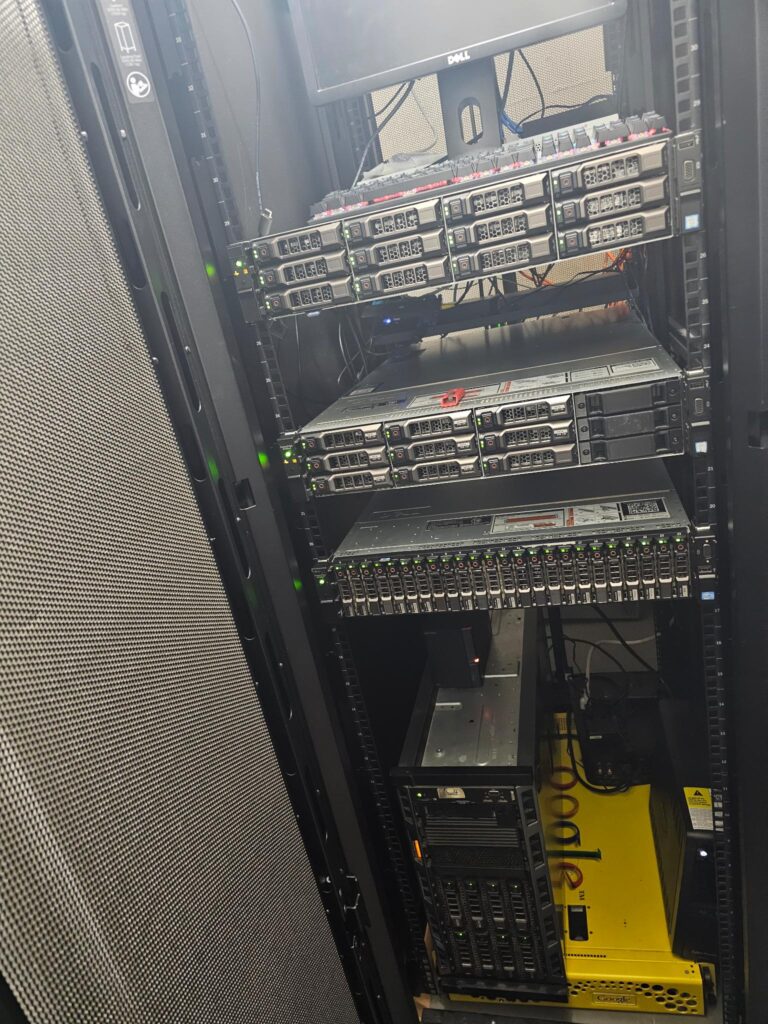
Although IT had always been a personal passion, it was during my time at Staples that I began collecting enterprise hardware and building what would become a full private cloud. It started with a Dell PowerEdge 2950, which opened the door to experimenting with hypervisors like VMware ESXi, Proxmox (KVM), XenServer, and eventually XCP-ng.
Having dedicated hardware allowed me to push past Type 2 hypervisors and fully explore Type 1 virtualization. This marked the beginning of an ever-evolving project. I initially deployed XenServer, but migrated to XCP-ng after its deprecation, setting up test environments with both Windows and Linux VMs. Over time, my homelab expanded into advanced networking, Cisco device emulation, user and domain management, and security architecture.
As the infrastructure grew into a full rack with four servers and enterprise-grade networking, the scope of my lab grew as well. What began as a playground became the foundation for my entire digital life. The cluster handled routing, cloud storage, VPN access, password management, SSO, SIEM, IDS/IPS, email, and a range of other services—many of which operated autonomously or supported users beyond my household. It offered constant access, redundancy, and control over my data and services.
Eventually, I added an off-site colocated server connected via site-to-site VPN to my home infrastructure. This server is logically divided: one part runs critical 24/7 services and stores off-site backups, while the other is reserved for hosting services for others.
Today, I use this platform to provide PKI-compliant web hosting, email services, DNS zone management, and more—all built and maintained on my own infrastructure.
Southeastern Career Center - Instructor
To further my own growth and give back to the field, I joined Southeastern Career Center as an IT Instructor, initially teaching CompTIA A+ and Network+ certification courses. As my experience and credentials expanded, I began offering Cisco CCNA and CCNP classes as well. Around the same time, I also became an off-site adjunct professor for Vincennes University, delivering certification-focused instruction in similar subjects.
This was one of the most rewarding periods in my career. The education space offers incredible opportunities for both staff and students to learn, experiment, and grow—working with both legacy and emerging technologies. I developed lesson plans, hands-on labs, and real-world learning opportunities by integrating student work directly into the school’s infrastructure projects.
Together, we built and outfitted a 30-PC computer lab, installed and mounted network closets and switches, ran structured cabling, and deployed over 50 new security cameras throughout the building. These projects turned abstract concepts into practical, resume-worthy experience for the students.
One initiative I introduced was called “Pet Projects”—a weekly assignment where students could pursue any IT-related passion project of their choice. The results were incredible. Students explored everything from:
Rebuilding a functional Pip-Boy (from the Fallout series) using an Arduino
Teaching programming languages
Practicing electronics soldering
Collaborating across disciplines—such as working with construction students to build a half-sized arcade cabinet and install a two-player emulation system for arcade and legacy console games.
These projects encouraged creative thinking, peer collaboration, and technical exploration beyond the curriculum.
Southeastern Career Center - IT Director
Alongside my work as an Instructor and Adjunct Professor, I was also appointed Interim IT Director at Southeastern Career Center (SCC) within my first year. This was a uniquely broad role—going beyond traditional system administration—due to the nature of the school itself. SCC is a trade-focused institution with over 15 career programs, including Construction, Culinary Arts, CAD, Graphic Design, Automotive, Nursing, Dental, Cosmetology, Criminal Justice, Heavy Machinery, Welding, and Information Technology.
Each trade department simulated its respective professional environment, often requiring specialized IT infrastructure, hardware, and software to support it. For example:
Criminal Justice used a firearms training simulator for tactical scenario instruction.
Automotive relied on a rolling dynamometer (dyno) for performance diagnostics.
CAD and Graphic Design utilized high-performance workstations with complex licensing and federated access.
Welding employed virtual welding simulators.
Culinary had IoT-based refrigeration monitoring and Point of Sale systems.
Precision Machining operated CNC mills and routers tied to digital design pipelines.
Cosmetology required state-mandated hourly tracking for certification compliance.
Managing the IT needs of these diverse environments meant supporting everything from Active Directory and Azure AD (now Entra ID) to Google Workspace for Education, along with countless federated cloud services, identity providers, and bespoke software integrations. I developed custom automation scripts and internal tools to improve consistency, reduce human error, and streamline onboarding and system access for both staff and students.
Beyond the technical responsibilities, the role also encompassed project management, state and federal grant/budget oversight, procurement and inventory tracking, and coordination with vendors and educational boards. It was a dynamic and high-impact position that required both hands-on expertise and long-term strategic thinking—blending education, enterprise IT, and cross-departmental collaboration into a single role.
ERPSuites - System Administrator Lead
My next role took me to ERPSuites, a Managed Services Provider (MSP) specializing in JD Edwards ERP environments. With approximately 1,500 virtual machines in active production and frequent client onboarding/offboarding, the infrastructure demanded high availability, consistency, and adaptability.
I originally joined the System Operations department as a System Administrator, and within my first year was promoted to Lead of System Operations. Our team provided technical support and systems management across customer domains, applications, and endpoints—primarily within Windows Server and Oracle Linux environments, while supporting other distributions as needed.
Client infrastructure was hosted in two on-premises datacenters across separate availability zones (AZs) using VMware ESXi and Oracle Linux Virtualization Manager (OLVM), as well as in cloud environments via AWS and Oracle Cloud Infrastructure (OCI). Customer implementations varied widely: some operated as standalone application domains, while others functioned as trusted resource domains within the customer’s existing forest. Each environment came with its own set of security requirements, compliance standards, patching schedules, and third-party integrations.
As department lead, I took on responsibilities beyond operations—including:
Acting as a subject matter expert (SME) and project lead for internal and customer initiatives
Participating in interviews and team development
Leading project design and cross-department collaboration
Creating and enforcing departmental policies and procedures
Serving as an escalation point for complex issues
A major focus during my tenure was the company-wide DevOps initiative, where I led automation efforts across departments using AWX (Ansible Web UI), with a planned migration to Ansible Tower. This included:
Automated customer onboarding/offboarding
Custom management workflows across infrastructure and system operations
Supplementary Bash and PowerShell scripts for environments where agentless automation wasn’t feasible due to client restrictions
I also provided internal support for company systems, including domain management, patching automation, and the creation of a secure, automated user onboarding/offboarding pipeline. This system was triggered via HR record creation, using API integration and webhooks, and included audit checkpoints and compliance safeguards for secure lifecycle management.